
Blocked automated sequence: the diagnostic order before opening the PLC
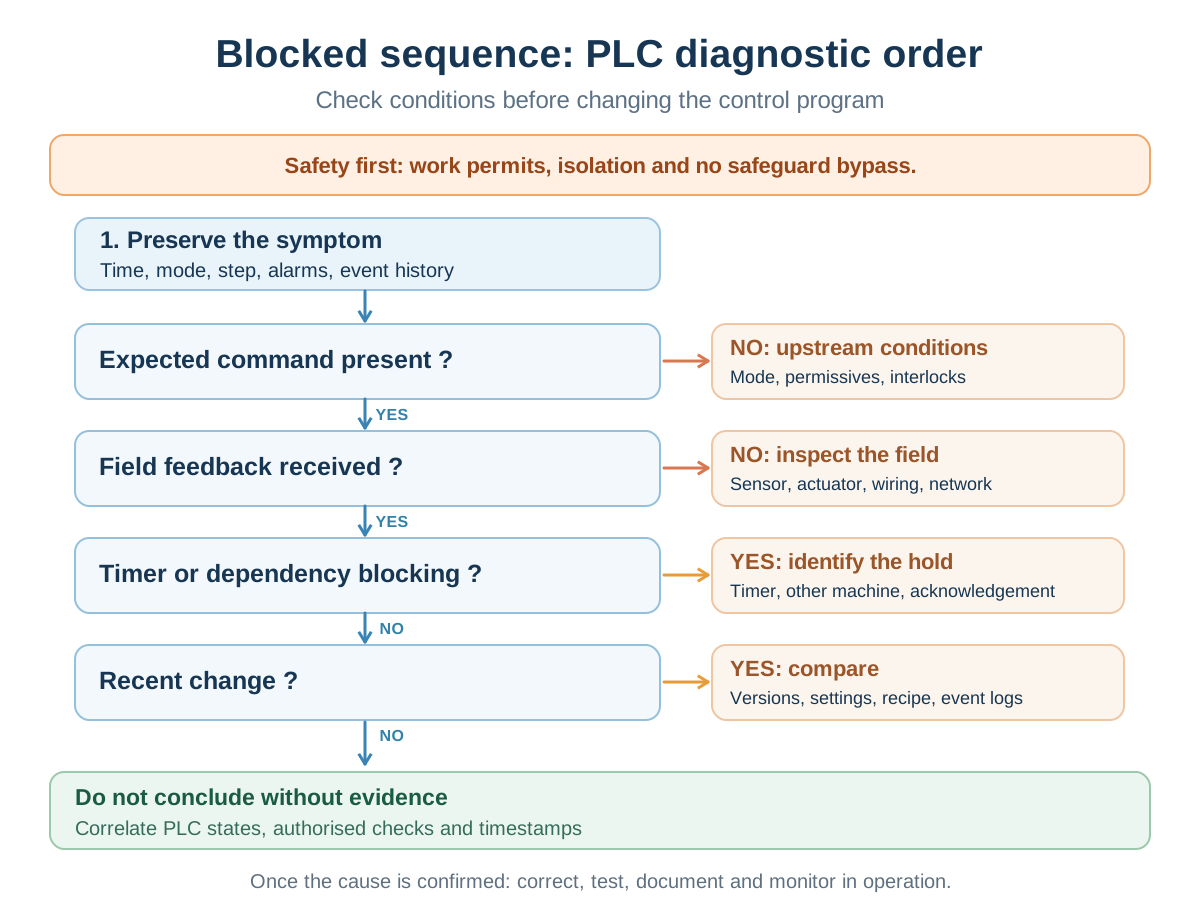
A blocked sequence does not yet identify the cause. The program may be waiting for field feedback, a safety condition, the end of a timer or the release of another piece of equipment. Before any change, the diagnosis needs to establish what the machine requests and what it actually receives.
Make the intervention safe and preserve the symptom
Site rules, isolation procedures and work permits remain the priority. Software diagnosis does not justify forcing a signal or bypassing a safety function. Operations staff should identify the state in which the fault appears, the last successful action and the conditions needed to reproduce the symptom without creating a risk.
A useful record keeps the time, operating mode, active step, alarms, recipe where relevant and the state of connected equipment. An immediate restart can erase part of that sequence of events. If production requires a restart, these facts should be captured before the action.
Read the command and feedback separately
For the expected action, the record separates at least four elements: the command calculated by the PLC, the output actually activated, the field feedback and the condition that authorises the next step. A green symbol on the HMI does not by itself prove that the device moved or that the expected sensor changed state.
Checks start with accessible field conditions within the authorised scope: power, protection, position, pressure, communication, drive fault or actuator state. The program is then read to understand the expected condition. This order avoids changing code when the PLC is correctly describing a physical fault or missing information.
Examine interlocks and sequence memory
A step may depend on a global permissive, upstream equipment, an acknowledged alarm or a request that remained active after a stop. The record should show the false condition and where it comes from. A copied list of conditions without their values at the time of the fault provides little evidence.
The diagnosis should also identify what latches the request and what is expected to clear it. A bit becoming false does not demonstrate that movement completed correctly. The event history needs to connect what created the request, the expected feedback and the transition that should have followed.
Separate facts from hypotheses
The report separates observations from possible explanations. “The PLC output is active and the contactor does not pull in” is an observation. “The coil has failed” remains a hypothesis until an authorised measurement establishes it. This distinction prevents an initial idea from becoming an official cause in the maintenance history.
Each hypothesis needs a check capable of supporting or rejecting it. Changing several timers, thresholds or conditions at once makes the result difficult to interpret. If a software correction is required, it should be versioned, reviewed and tested with rollback criteria defined before the trial.
Prepare a verifiable restart
The return-to-service record states the test conditions, observed cycles and outstanding reservations. A few successful cycles establish operation under the tested conditions. They do not yet demonstrate that the problem will not recur over several weeks.
Our industrial troubleshooting service can structure this diagnosis with the site team. The maintenance follow-up then retains the symptom, checks, change and monitoring points. Vanguard Systems’ background and skills and the published references provide context for the assignments presented on this website.